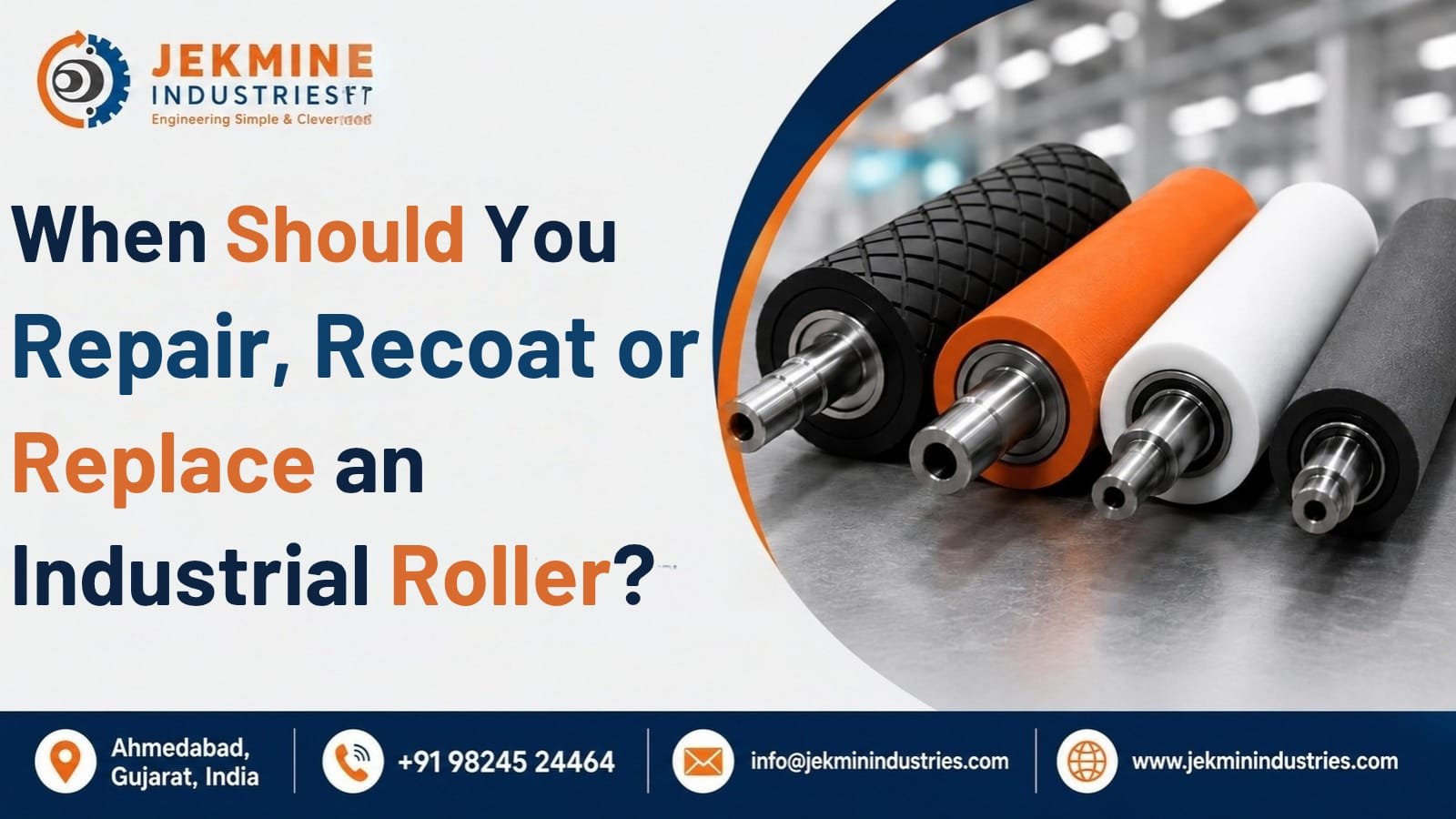
Industrial roller plays a very critical role in industries like manufacturing, packaging, printing, textiles, steel processing, etc. The main question to be answered here is whether to choose industrial roller repair, roller recoating or complete industrial roller replacement. You can go for an experienced industrial roller manufacturer who will inspect your equipment and provide you with the best cost effective solution.
Signs that a roller needs immediate attention
Routine inspections help to identify the problems before they can affect the production. Check for the mentioned signs:
- Excessive vibration.
- Uneven product finish.
- Noise caused by worn out bearings or shafts.
- Hardened rubber covering.
- Cracks, cuts or peeling of the surface.
What is roller recoating?
Basically, roller recoating means removing the worn rubber, polyurethane or the speciality covering of the existing roller and then applying a new coating. The core is cleaned, repaired if necessary and then coated with materials that are appropriate for the intended operation.
Is it possible to recoat industrial rollers?
Yes, many industrial roller systems can be successfully recoated but this also implies that the metal core and shaft is structurally strong. Performance will be restored in the process and the costing will be significantly less as compared to complete replacements.
When recoating is possible?
Recommendation for recoating is given when:
- There is no structural damage to the roller core.
- Only the outer covering shows signs of wearing.
- The shaft is perfectly aligned and remains straight.
- Dimensions of the roller meet the production requirement.
- Safe support for new coating can be provided by the existing core.
When is it possible to reuse the core or shaft?
Most of the industrial roller cores are made in such a way that they can handle multiple recoating cycles. Reusing the core is practical when:
- Corrosion is minimal.
- There are no structural cracks.
- The shaft remains within tolerance.
- Bearings can be replaced if necessary.
When is it safe to go for complete replacement?
You will need to go for complete replacement of the roller coating if:
- The core is heavily corroded. There are structural cracks.
- The shaft is bent or damaged.
- The roller no longer meets production specifications.
- Repeated and uneconomical repairs become necessary.
Cost factors
The overall maintenance cost depends on factors like:
- Size and weight of the roller.
- Condition of the core.
- Requirement for surface finish.
- Coating material.
- Machining or balancing needs.
Inspection checklist
Before making the final decision, you have to inspect for:
- Surface wear.
- Core corrosion.
- Rubber hardness.
- Dynamic balance.
- Coating adhesion.
- Bearing condition.
- Straightness of the shaft.
Questions you should ask a roller manufacturer
Before choosing the service provider, do not forget to ask:
- Is it possible to recoat the roller?
- Is the core appropriate for reuse?
- Is any warranty included?
- The turnaround time.
- Best coating material.
How can you extend the service life of the roller?
The basic things to ensure expansion of the roller's lifespan include:
- Regular cleaning.
- Avoiding exposure to incompatible chemicals.
- Scheduled inspections.
- Replacing worn bearings promptly.
- Following manufacturer's recommendations.
FAQs
1. Can I recoat the industrial roller?
Yes, you can recoat the industrial rollers.
2. What to do if the core is not strong enough?
In that case you will have to go for complete replacement.
3. How often should we inspect the industrial rollers?
This depends on the operating conditions and workload.